
Introduction
Recruiting for one public safety division is a challenge. Recruiting for three at the same time, each with its own candidate profile, its own brand, and its own hiring timeline, is something else entirely.
That was the reality facing the City of Columbus Department of Public Safety. With active recruitment needs across the Columbus Division of Police, the Columbus Division of Fire, and the Columbus Emergency Communications Center (ECC), the department needed more than a campaign. It needed a coordinated, multi-division recruitment strategy built to generate serious candidate volume while maintaining the quality and engagement necessary to move people through the hiring process.
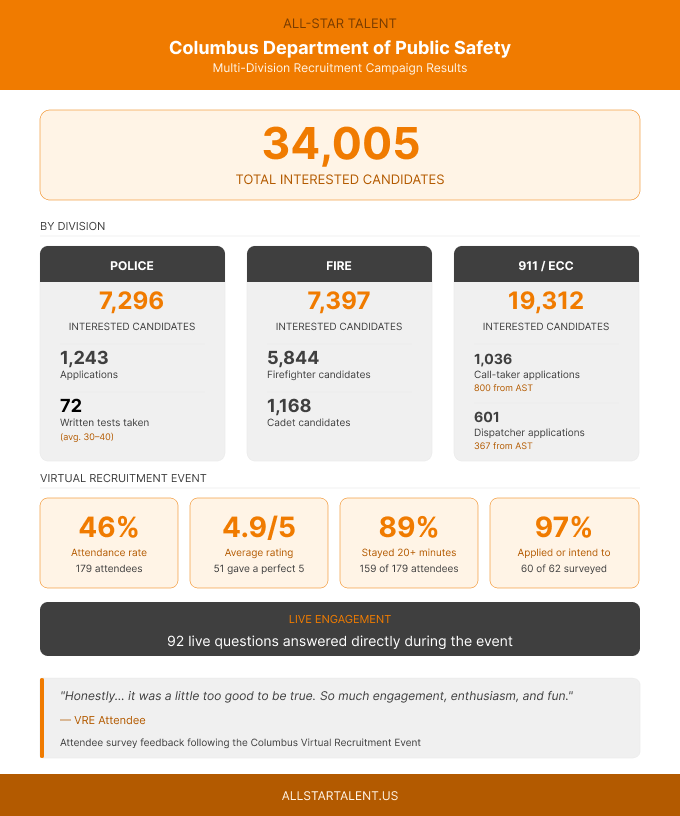
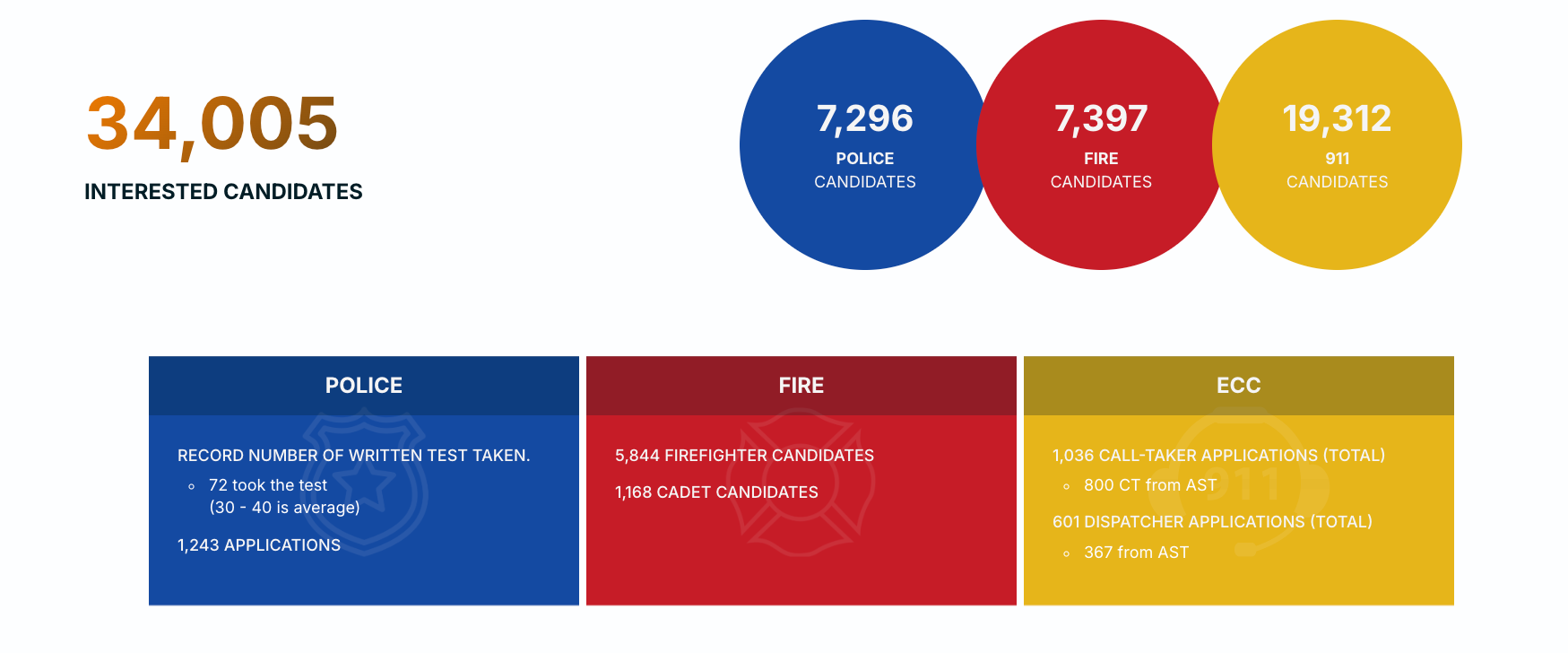
All-Star Talent was brought in to build that strategy. What followed was one of the most comprehensive public safety recruitment campaigns we have executed, resulting in 34,005 interested candidates across all three divisions, record-breaking application and testing numbers, and a virtual recruitment event that made it easier for candidates to connect directly with the agency, ask questions, and get the information they needed. Attendees expressed genuine appreciation for the accessibility and opportunity to engage with recruiters in real time.
This is how it came together.
The Challenge: Three Divisions, One Coordinated Campaign
Public safety agencies rarely face a single recruitment challenge. More often, they are managing multiple hiring needs simultaneously, each requiring its own messaging, its own audience targeting, and its own candidate experience. Columbus was no exception.
The Columbus Division of Police needed to expand its applicant pool and increase the number of candidates completing the written examination, a step in the hiring process that had historically seen limited turnout. The Division of Fire needed to attract candidates at two distinct entry points, experienced firefighters and cadets, requiring two separate messaging approaches under one campaign umbrella. The ECC needed to fill call-taker and dispatcher positions, roles that are chronically difficult to recruit for in part because fewer candidates understand what the job actually involves or why it matters.
Addressing all three simultaneously required more than coordination. It required a strategy built on differentiation, a system capable of managing candidate relationships at scale, and content that could cut through on the platforms where candidates were actually spending their time.
Building the Campaign: Strategy, Content, and Infrastructure
All-Star Talent approached the Columbus engagement as an integrated campaign rather than a set of parallel efforts. While each division had its own recruitment identity and candidate audience, the infrastructure supporting all three was unified, allowing for centralized tracking, consistent follow-up, and efficient use of resources across the board.
The foundation of the campaign was the All-Star System, a centralized candidate database that handled pre-screening for qualifications, automated relationship-building through continuous outreach, and kept candidates engaged from initial interest through application and beyond. Alongside that, the All-Star App gave the Columbus team real-time visibility into the candidate journey, tracking movement from first contact through testing and background stages while enabling two-way communication via email and SMS. For agencies that have historically struggled with candidate drop-off during long hiring timelines, this kind of infrastructure is not optional. It is what keeps pipelines alive. You can learn more about how these integrated systems support recruitment outcomes on ou Integrated Communication Solutions page.
On the content side, All-Star Talent produced recruitment videos for all three divisions, each designed to reflect the distinct culture and opportunity of that role. The recruitment video consistently outperforms static creative when it comes to candidate engagement, and the Columbus production was built to do exactly that: stop the scroll, build emotional connection, and give serious candidates a reason to take the next step. You can see the full video embedded in this article, and explore more examples of what recruitment video looks like in practice in our Recruitment Video Gallery.
[Add police video]
Fire content was developed to speak to both experienced candidates and those entering through the cadet pathway. ECC content worked to demystify the 911 dispatcher role and make it feel aspirational rather than overlooked, a shift in positioning that is often essential for recruiting into that space.
Digital advertising campaigns ran across platforms targeting relevant candidate demographics for each division. A unified recruitment landing page was built to house active opportunities across Police, Fire, and 911, with clear messaging around each division's mission, values, and career paths. This kind of dedicated landing page infrastructure consistently improves conversion by giving candidates a focused, distraction-free path from interest to application, something we cover in depth in our work on recruitment consulting strategy.
The Police Results: A Record Written Test and a Full Pipeline
The Columbus Division of Police campaign produced results that stood out even within a campaign full of strong outcomes.
Most notably, the written examination, a step that had historically seen 30 to 40 candidates participate on average, drew 72 test-takers during this recruitment cycle. That is nearly double the top end of the historical average, a result that reflects not just broader awareness of the open positions, but meaningful candidate engagement throughout the funnel. People were not just clicking on ads and disappearing. They were moving through the hiring process.
The campaign generated 7,296 interested police candidates total, with 1,243 applications submitted. For a law enforcement agency operating in a national environment where recruiting qualified officers has become one of the most persistent operational challenges agencies face, numbers like these represent a genuine shift in trajectory. Our work supporting law enforcement recruitment consistently shows that reaching this level of applicant volume requires more than advertising spend. It requires a system that stays in contact with candidates and a brand presence that earns their trust before they ever hit submit.
Fire and ECC: Volume and Specificity at Scale
The Division of Fire campaign reached 7,397 total candidates, including 5,844 interested in firefighter positions and 1,168 pursuing the cadet pathway. Attracting candidates at two experience levels simultaneously is a challenge that requires careful message segmentation. Experienced firefighters respond to different cues than people just entering the field, and a campaign that conflates the two typically underperforms with both audiences. Keeping those tracks distinct while maintaining a cohesive division brand was one of the more nuanced execution challenges of the Columbus campaign, and the candidate numbers reflect how well that balance was achieved.
The ECC results were perhaps the most operationally significant of the three. The 911 communications space is one of the most difficult recruiting environments in public safety. Turnover is high, public awareness of the career is low, and candidate pipelines are often thin across the country. All-Star Talent generated 19,312 interested ECC candidates during this campaign, a number that would be notable even as a standalone effort. On the application side, 1,036 call-taker applications were submitted, with 800 of those directly attributable to All-Star Talent's efforts. Of the 601 dispatcher applications received, 367 came from AST-generated candidates.
These are not just volume numbers. They represent a sustained pipeline of qualified, informed candidates who understood the role they were applying for, a distinction that matters enormously when it comes to retention and long-term hiring outcomes.
The Virtual Recruitment Event: Engagement That Reached A Big Audience
One of the defining moments of the Columbus campaign was the Virtual Recruitment Event, a format that All-Star Talent has refined as a tool for converting interested candidates into committed applicants. Candidates who express interest in a position are not always ready to apply. Sometimes they have questions. Sometimes they need to hear from real people inside the organization before they take the next step. The Virtual Recruitment Event is designed to bridge exactly that gap. You can learn more about how these events work on our Virtual Recruitment Events page.
The Columbus VRE drew 179 attendees, representing a 46% attendance rate among those who registered. That number alone is strong. What happened during the event was what made it exceptional.
Attendees submitted 92 live questions, with additional engagement flowing through the live chat throughout the session. 89% of attendees, 159 people, stayed engaged for 20 minutes or more. 61%, 108 people, remained for 50 minutes or longer. In an environment where online attention spans are notoriously short and public trust in government institutions is often fragile, those engagement numbers reflect something meaningful: candidates who came with genuine interest and left with a stronger sense of purpose.
The post-event survey data reinforced that. Of the 62 attendees who completed the survey, 97% reported they had already applied or intended to do so. Only two indicated they were unsure. None reported no intention to apply. The average event rating was 4.9 out of 5, with 51 respondents giving a perfect score.
The attendee feedback said it more directly than any metric could. One candidate noted, "Honestly, it was a little too good to be true. So much engagement, enthusiasm, and fun. Surprised that this was the first virtual thing you've held." Another wrote, "I appreciate how all aspects were handled and not just pay. Quality of life and how to give back are essential, so seeing those highlighted strengthened the notion of applying." A third, reflecting on the value for out-of-state candidates, said, "I have had so many questions being a potential out-of-state lateral hire. This event really helped with easing some of the stress on the logistics side of things."
These responses point to something that recruitment advertising alone cannot deliver: a sense of connection, clarity, and confidence. The Virtual Recruitment Event gave candidates a reason to commit.
What This Campaign Demonstrates
The Columbus Department of Public Safety campaign is a case study in what becomes possible when recruitment strategy, content, technology, and candidate engagement work together as a unified system rather than isolated tactics.
The 34,005 total interested candidates were not generated by a single clever ad. They were the product of a coordinated campaign that put the right content in front of the right audiences, captured that interest through a structured candidate management system, nurtured relationships over time through consistent communication, and created meaningful touchpoints that converted curiosity into commitment.
Record written test participation for the Division of Police. Dual-pathway candidate generation for the Division of Fire. A 911 pipeline that reversed the chronic shortage narrative for ECC. And a virtual recruitment event that left candidates more informed, more confident, and more motivated to apply than when they arrived.
This is what modern public safety recruitment looks like when it is built on strategy, not just spend. If your agency is navigating similar recruitment challenges, we would welcome the opportunity to show you what a campaign built around your specific needs could achieve. Learn more about All-Star Talent's approach or view our full case study portfolio to see more results like these.

Jason is the inventor of a data driven, engineering based law enforcement recruiting process which has worked at the federal, state, county, special district, and local level. Jason has a deep understanding and knowledge in recruiting, marketing, and branding with over 23 years in consulting and executive roles and is a frequent speaker on employer branding and considered as the leading expert in the field of law enforcement recruitment.
